

Subscribe To Our Newsletter!

.svg)

PEAKS & PUEBLOS
Subscribe To Our Newsletter!
Subscribe To Our Newsletter!
Subscribe To Our Newsletter!
Subscribe To Our Newsletter!

India's Nanda Devi, part two: deep time and a lake of skeletons
The second in a series exploring “the world’s most romantic mountain”, this is the story of Nanda Devi as a geological and pre-historic goddess.

Deep time and the countless stories of place
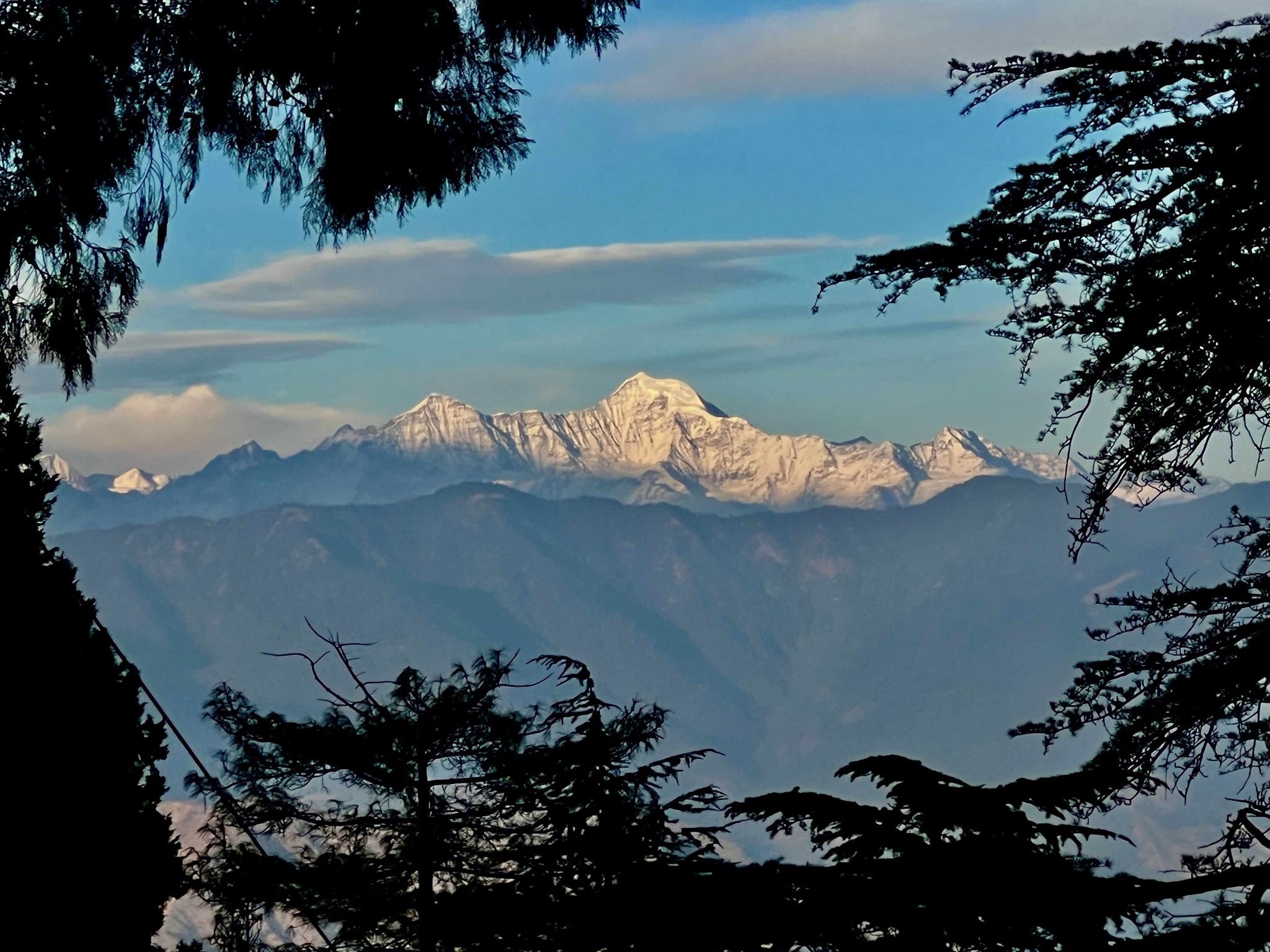
Upon arrival in the towns and villages near to Nanda Devi, it quickly dawned on me that the myths and stories attached to this mountain are far too numerous for one person. Amid the ancientness of the place and the vastness of the mountain, alone, I could never hope to learn, let alone recount the bewildering array of perspectives that collide here.
Perhaps a more practical task for me, however, is where to start. Even among the selection of stories I have chosen for this series, this isn’t easy. The most sensible option might be to continue a lineage of travel writing about this place, but unfortunately this is largely a story of European explorers and climbers that, to my mind at least, relegates something fundamental. Beyond the problems of colonial era narratives, from all the writing about Nanda Devi little is said about the mountain’s age.
Then again, what does it mean to understand that Nanda Devi, and her sisters across the Himalayas, were made over the last fifty million years? What does it mean to learn that this rock, thrust upward by the crashing of India into Eurasia, is between three and six hundred million years old? Or that the minerals from which that rock emerged are over a billion years old?
These ages of geology, often described as “deep time”, are periods of process so far beyond our lifespans that to attempt to think or feel in their terms is rendered meaningless. Yet these mountains have existed, rising and eroding, throughout eons of continuous change. The mountain will have known conditions, formations and transformations of unfathomable variety, and will have played host to immeasurable encounters of geological, atmospheric and biological becoming. For us, this cannot be comprehended. But it can, perhaps, be appreciated.
In many ways, this is a deep appreciation not just of time in the way we usually understand it but of complexity and multiplicity more broadly. Every place, everywhere, has an immeasurable background of stories upon stories, the incalculable majority of which have been recorded only by the place itself. Layer upon layer, appreciating this complexity of place over time is a lesson in humility for what lies beneath our feet.
In terms of Nanda Devi, one story that begins, in the smallest of ways, to speak of this mountain’s age, and of the role time plays in this place, is the story of a lake. As a story, it also demonstrates the sometimes surreal interplay of fact and fiction, science and folklore, as well as the broader reality that sometimes, despite all the best will in the world, our stories open up as many questions as they do answers.
The lake of skeletons
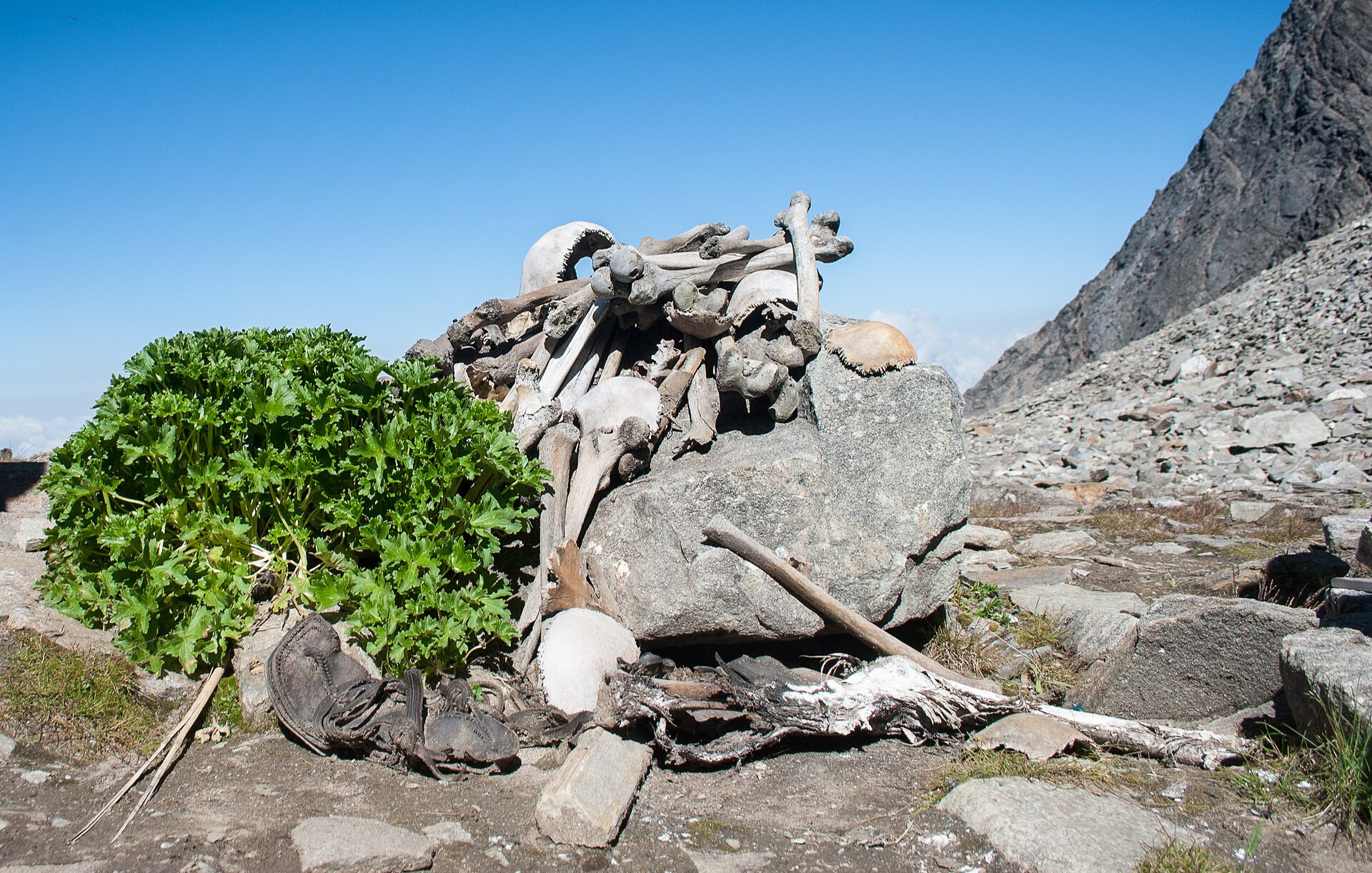
Just above 5,000 metres, near the foot of Trishul (7,120m) on the outer rim of Nanda Devi’s fortress to the South, there is a small glacial lake called Roopkund. Well above the snowline, the lake’s waters are frozen for eleven months of the year.
Only about 40 metres across at its widest, the lake itself is quite unremarkable. In some ways, it’s simply a pooling place for icy water amid a practically endless quantity of rocky scree, which slowly descends the mountain’s edges under gravity’s relentless draw. This place is notorious, and it carries the unusual name of Skeleton Lake.
The reason for this ominous title is that both inside and around these deep blue waters lie the remains of between three and eight hundred human bodies. In some reports, the lake is described as being “filled with bones”.
Found by Indian Forestry Department Officer Hari Kishan Madhwal in 1942, forensic analysis by investigators, including radiocarbon dating by researchers at Oxford Brookes University, determined that these grim remains date mostly from two separate periods. The first is between 675 and 770 AD, while the second is between 894 and 985 AD.
Although many theories have been offered as to who these people were, they were probably pilgrims who had come to visit this sacred mountain well over a thousand years ago.
Today, the Raj Jat Yatra pilgrimage is made to Nanda Devi once every twelve years. The 22 day, 280 kilometre march is a celebration of the goddess Nanda Devi, and marks her journey from her father’s home to that of her husband. The question of how long this ritual has been enacted is a difficult one to answer, with few written records beyond a couple of centuries. The best we can say with any certainty, in light of the bones at Skeleton Lake for example, is that it is very, very old.
Both local folklore and scientific research seem to agree that the majority of the human remains found at Roopkund are from people who were met with not one but two catastrophic natural disasters. Several hundred years apart, and high on the mountain, the strongest evidence yet is that these people died as a result of hailstorms.
Traditional folk songs tell this story, with one describing a goddess so outraged that her mountain paradise had been defiled, that she rained down death in the form of “ice as hard as iron”. A similar tale details a king, his queen and their entourage visiting the mountain while she was pregnant. In this version, the group celebrated a little too heavily, and the mountain punished them for this blasphemy and for visiting the goddess while bearing a child.
The investigators who analysed the bones from these people concluded that death was most likely the result of hailstorms due to the sizes and placements of impacts to the bones (i.e. to the heads and shoulders). While cricketball-sized hailstones are extremely rare, they are a phenomenon known to the high mountains. But what feels extraordinary is that two such events could take place in exactly the same spot far higher on a Himalayan mountain than anyone would usually care to go.
Yet, there is more. Almost beyond belief, some of the bodies analysed also appear to have been from people who died around 1800, roughly a thousand years after the first group. To science, this is an incredible coincidence: why would large numbers of people be found dead at the same small lake high on a mountain, in at least two episodes separated by a millennium?
For my two cents, I cannot but wonder whether something else was at play. But before I come back to that, remarkably the story continues to baffle. A 2019 DNA sequencing of 38 skeletal remains, published in the journal Nature Communications, showed that those from the 7th to 10th centuries were from South Asia - as you might expect - while a later group, dated to around 1800, were probably from the eastern Mediterranean, possibly Crete. One further individual from this later period was of Southeast Asian ancestry.
The Mediterranean connection is hard to ignore, as it is well documented how traders, missionaries, armies and others have for thousands of years moved between Europe and Asia via what is known as the Silk Road. In some areas of the Himalayas and adjacent ranges, there are even small ethnic communities whose oral histories trace their lineage to Alexander the Great and his followers. That era is far earlier than the bones, but it shows how long these routes were travelled. These paths are normally described in economic terms, but surely there was, as there is today, a spiritual and pilgrimage dimension to the journeys people used them for.
The point is that it is not unimaginable that Nanda Devi, before the advent of reliable written evidence, was a site of special spiritual interest to the wider world as well as to those in India. Long before any of today’s national borders existed and before technology made travel so much easier, it may be that Nanda Devi as a goddess was revered over much greater distances. And, as I will suggest, this may have been taking place long, long before these people died at Skeleton Lake.
As with Varanasi further down the Ganges, it may be that people came here not just to revere a famous source of life but also to pay homage to death. Perhaps they even came here to die. There is, of course, little evidence for this, but I cannot help but wonder about that lake, and the coincidence of those hailstorms, and what that place might really have been for.
How long have we revered Nanda Devi?
Regardless of the precise nature of how these people died, for devotees of Nanda Devi these were the moral actions of a living goddess. A giver of life and also a taker. For me, this is another stunning reminder that this mountain has been sacred for a long time, with people revering this place as a deity in physical form for thousands of years.
While this region is known to be where many of the founding stories of Hinduism, one of the world’s oldest traditions, derived, prevailing scientific wisdom suggests that anatomically modern humans arrived in the Himalayas only in the last 20,000 to 30,000 years. Evidence suggests that high-altitude settlements in the mountains only began in the last three to four thousand years.
In 1980, however, a Buddhist monk meditating in the Baishiya Karst Cave over the border in Tibet discovered a jawbone that has since become known as the Xiahe Mandible. This bone proves that archaic hominins - Denisovans - lived in this part of the world, at altitude, up to 160,000 years ago.
In recent years, the dominant narrative that civilisation emerged only as a result of agriculture is being increasingly questioned. The 11,000 year old site of Göbekli Tepe in Türkiye is one example of an ancient site built around ceremony, rather than just the social results of farming. In other words, the earliest signs of human culture are now increasingly beginning to be understood as communal, spiritual and religious in nature, rather than only economic or about survival.
Perhaps the discovery of this ancient cousin of ours high in Tibet is a signal that mountains, and of course other features of the landscape too - such as rivers, forests, and much beside - may have captivated us long before we were even an “us” to describe ourselves as.
Is it too much of a jump to imagine, before the first stone sites of ceremony were built, that early humans may have revered features of the natural world instead of the monuments, cathedrals and relics made for us by our priests and shamans? Could it be that not just mountains, but specific mountains, and even specific sites on mountains - such as Roopkund Lake - drew us vast distances to pay homage to the water, food and life they give?
Does a mountain remember?
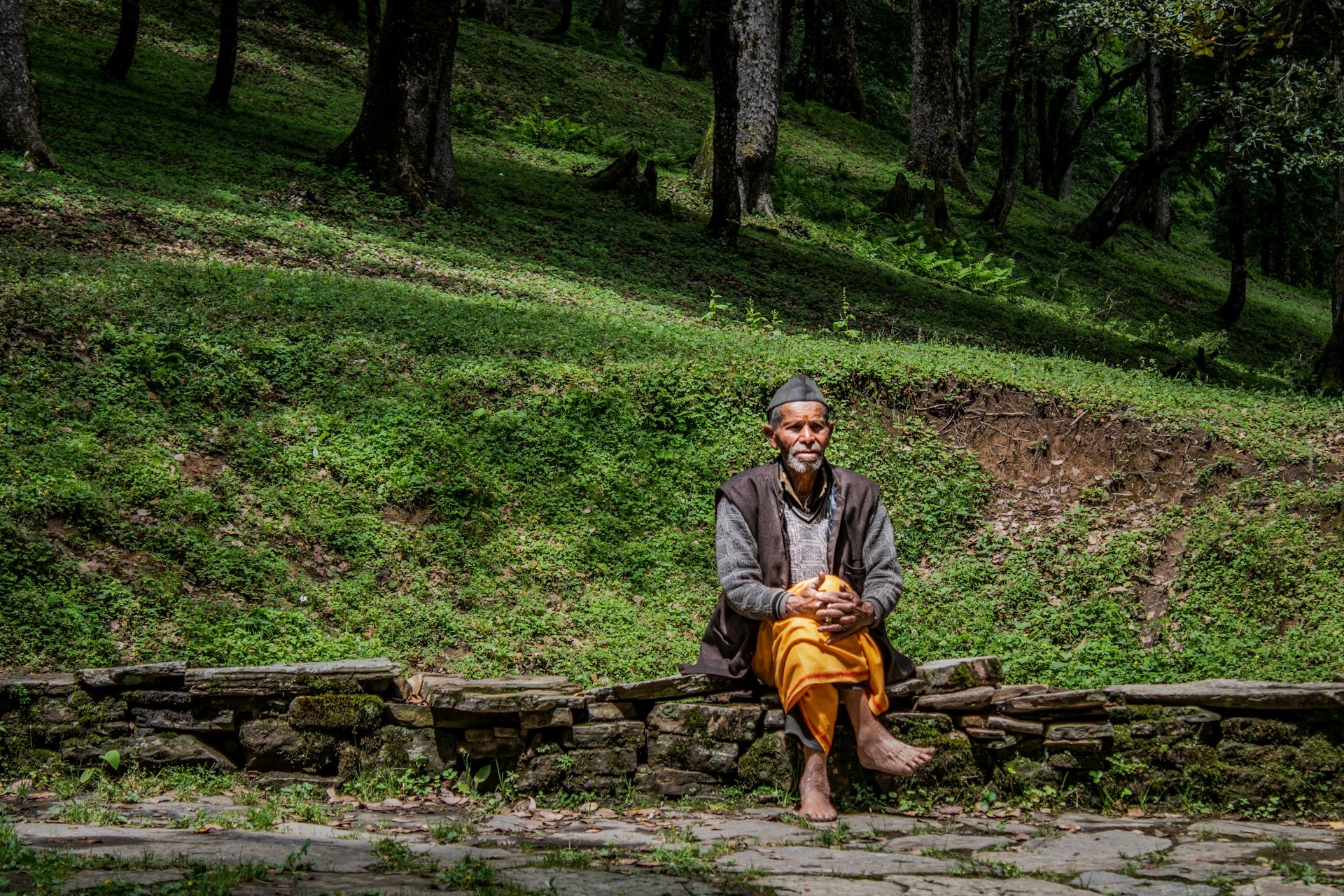
Perhaps this is why the question of who Nanda Devi's devotees really were, and when they first came, resists a simple answer: not only because the record is thin, but because the very idea of "when" may not be the right question to ask of a mountain.
Most of us conflate time and its measurement. We mostly find it perplexing to imagine other experiences of time beyond the chronological. Other experiences are well documented, however, and in ancient Greece, Chronos - the godly personification of chronological time - was just one of a number of representations of time (think Kairos, Aion, etc.). Global cultures too have myriad ways of understanding time.
In some indigenous traditions, for example, the Earth is understood not only as an animate mother figure but also the location of the past (sometimes with the future being the sky or at the horizon). Being where the dead go, and where archaeologists dig, the Earth becomes both a place and a past. The point, however, is that for us humans our landscapes are not always just where events take place.
Unconditioned by the march of chronological time codified in Western Europe in the seventeenth and eighteenth centuries, and spread around the world in the past two hundred years, some cultures still hold more cyclical, celestial and nature-based ways of experiencing time. In the case of Nanda Devi, we may be dealing with a place, but also the past of this place.
Whichever way you look at it, the mountain’s deep time is a source of humility for us, and another route by which we can empathise with people who consider the rock and ice of Nanda Devi to be intelligent, vibrant and full of life, as well as the embodiment of a powerful sentient goddess.
The meltwaters of this mountain feed the Ganges, and with it the lives of hundreds of millions of people. A goddess to some, a life-giver to many, and a keeper of a past far longer than our own, in the articles to come, I want to ask what we owe to a place like this.
Header image credit: Anuj Yadav
Sam Williams
A beyond-profit project manager, community builder and social entrepreneur, Sam shares stories about mountains, climbing, nature connection, and the meaning of adventure in a more-than-human world. He is currently working on a series entitled The Mountains are Gods exploring stories of sacred mountains. To find out more visit Reflexive Ecology. You can also find him on LinkedIn and Instagram.
Latest posts

An urgent message from the Kogui of Colombia to the engineers of AI.
After injury, failure, and a mental wall that no amount of trail could fix, one runner rediscovers why the distance was never really the point.
Subscribe To Our Newsletter!
PEAKS & PUEBLOS
Subscribe To Our Newsletter!
PEAKS & PUEBLOS
A global adventure community, celebrating stories of meaningful travel and exploration.
Subscribe To Our Newsletter!
Subscribe To Our Newsletter!
PEAKS & PUEBLOS
Subscribe To Our Newsletter!